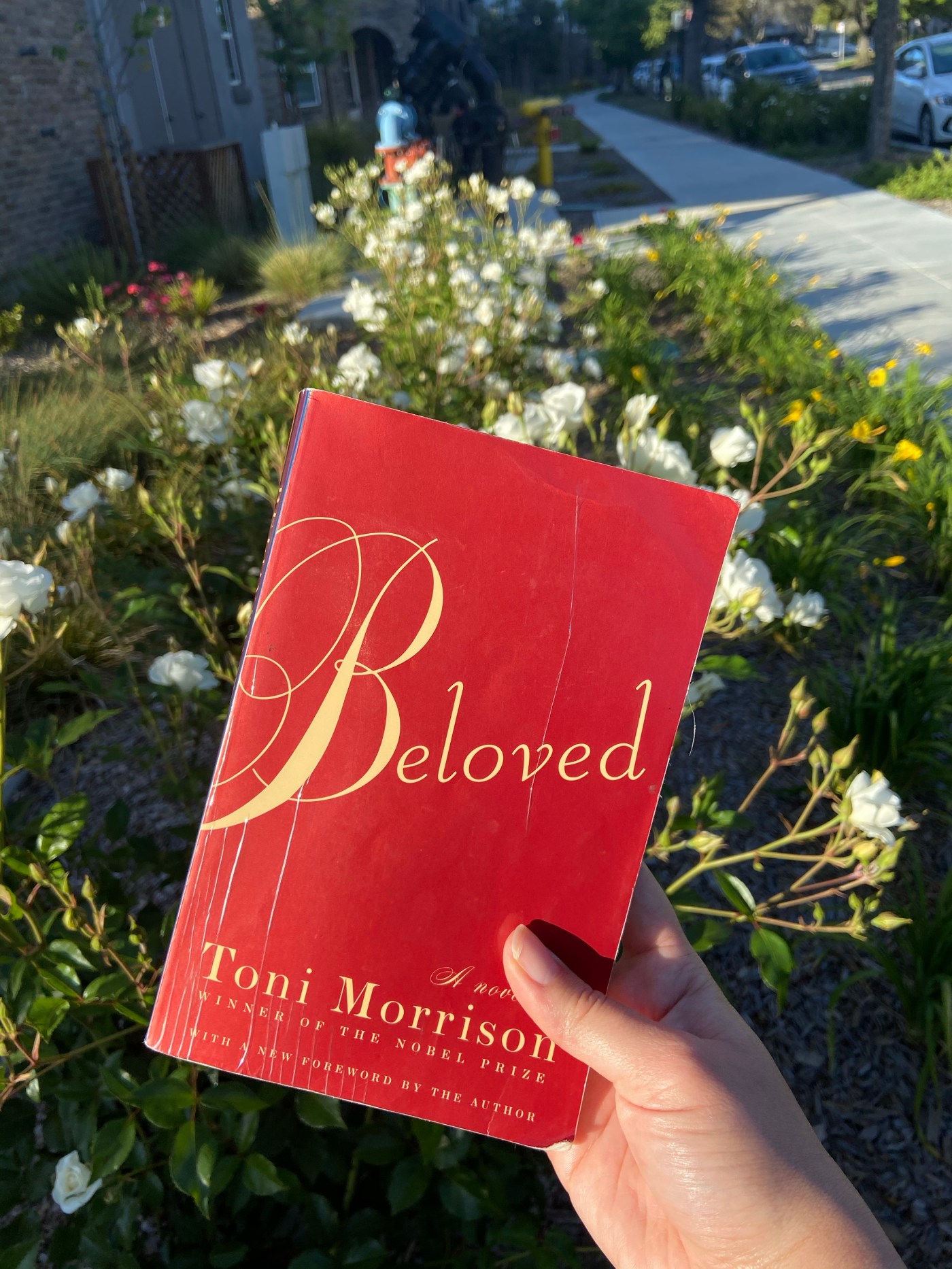
- Readability: 7/10
- Emotional connection: 10/10
*SPOILER ALERT*
I started reading Beloved knowing that it’s a critically acclaimed novel. I’ll admit that for me, it wasn’t easy to read. Although it’s not very long, it took a few weeks to read it because each chapter felt emotionally taxing. This was partly due to the mysterious story and language, but mostly because of the emotionally painful story. Beloved shows both the horrors of slavery and of the trauma it inflicts after the people have escaped. The book mainly focuses on Sethe, a lady who escaped from slavery with four children (though they didn’t all travel together) to a house outside Cinncinati referred to as “124”. The book goes back and forth from the past to the present, shedding light on how the events of the past have impacted the troubles of the present. From learning that some of the men at the farm called “Sweet Home” stole the milk from Sethe’s breasts to the school teacher trying to bring her back after she and her children escaped, to her crime done out of love and the judgment she faces from her neighbors, life is tiresomely difficult to Sethe.
Paul D, another ex-slave from Sweet Home who later finds Sethe, has also been troubled immensely since Sweet Home – from the brutal treatment of the school teacher to the inhumane imprisonment in Georgia, to his second escape, and further wanderings, his heart has been hardened into a “tobacco tin,” and he believes that “the best thing…was to love just a little bit, everything just a little bit; so when they broke its back, or shoved it in a croaker sack, well maybe you’d have a little love left over for the next one” (54). When he learns of Sethe’s crime, he asserts that her love was “too thick,” suggesting if she hadn’t loved her children so much, they all would’ve been better off, and perhaps she wouldn’t have committed her crime of infanticide. She loved her children so much that she thought they were better off dead than in slavery.
Throughout the story, Sethe wrestles with guilt and anger about the past, and struggles to move on with her life. In turn, her daughter, Denver grows up in isolation, in fear of both her mother and the outside world. When Paul D, another ex-slave from Sweet Home, and Beloved, the reincarnated flesh of Sethe’s dead daughter, come into their lives, everything changes, and not for the better (at least at first). Sethe is forced to deal with the past and starts to abandon her responsibilities among the emotional distress of dealing with Beloved, while Denver is forced to grow up and take responsibility for her family due to Sethe’s state. When Denver seeks help, the black community, who has not interacted with the inhabitants of 124 for years because they disapproved of Sethe, realizes they have been prejudiced. Only with the power of the community can they heal and embrace the future.
Lastly, I found myself racked with emotion when hearing about how the newly freed people in the story embraced their independence, though sometimes it was perplexing to them. When Baby Suggs, Sethe’s mother-in-law, becomes free, she has a realization for the first time that her body is her own, and she can do whatever she wants. She seizes the opportunity to preach Christianity and inspire and take care of everyone in the community. When Sethe comes to 124, she realizes that “Freeing yourself is one thing; claiming ownership of that freed self was another” (111-112). Throughout the story, she and Paul D struggle to find their identities as freed people – not just as a mother or ex-slave, but as their own person’s whose lives matter. Meanwhile, Denver forms her identity as her own person, instead of simply an extension of her.
And at one point, Paul D thinks, “To get to a place where you could love anything you chose – not to need permission for desire – well now, that was freedom” (191). It seems that this is the characters’ destination in the book – getting to a place not only physically, but also mentally, where they can feel free to love without the enormous guilt and burdens of the past weighing too heavily on them. Once they are able to come to terms with the past, they can become more forward-looking and feel more hopeful about tomorrow.
All in all, this book is a distressful yet inspiring read. I believe it is important to read novels such as these because though fictional, it shows how humanity can confront agonizing histories, whether personal or societal. And, it forces the reader to look at the painful background behind actions that seem despicable at first glance. To me, it is a reminder that we should not be too quick to judge others, as you never know why they are acting in a certain way. While you might not agree with someone’s thoughts or actions, it’s important to empathize and understand where they’re coming from to gain a greater understanding of the big picture. This is especially important in the polarized political climate of the U.S. today. In order for society to progress, opposing sides must work together to find common ground. Morrison reveals that no matter how dire a situation is, the largest obstacles can be overcome.
 The Bay Area Bookworm
Leave a comment